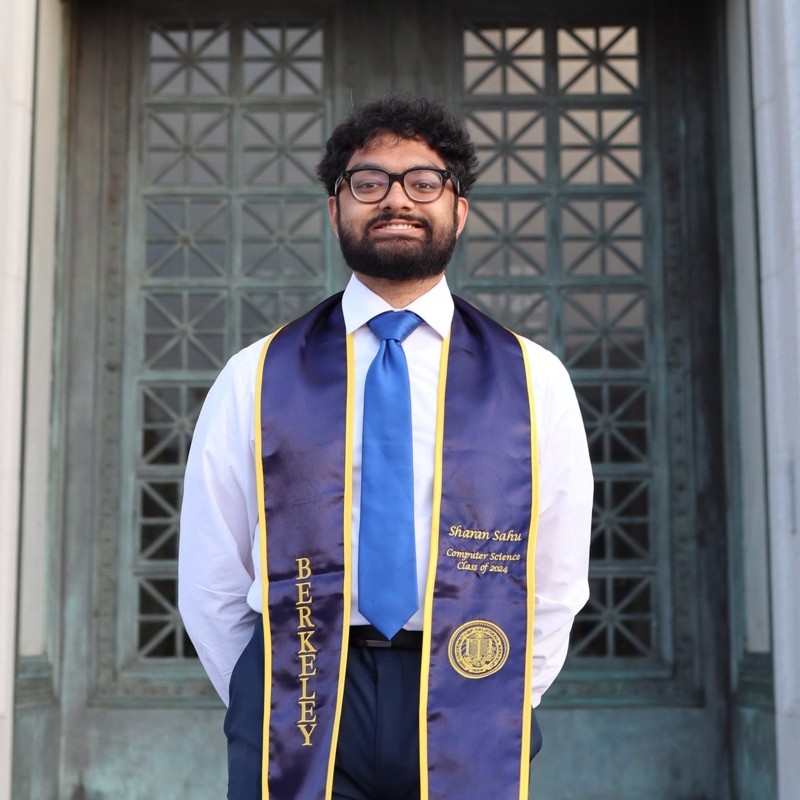
I am a third-year PhD student in Statistics and Machine Learning at Cornell University, advised by Martin Wells and Yuchen Wu.
I am interested in statistical machine learning and establishing rigorous foundations for statistical and machine learning methods, while also developing new algorithms guided by theoretical insights. I am fortunate to have been supported by a Cornell University Fellowship.
Before Cornell, I was an undergraduate at UC Berkeley studying Computer Science, where I was advised by Iain Carmichael and Ryan Tibshirani.
If you're an undergrad or Master's student at Cornell and are interested in collaborating, please reach out!
News
| Oct, 2026 | New preprint online: We characterize the tradeoff between reward maximization and reliable inference on current treatment effects in nonstationary multi-armed bandits, establishing matching minimax bounds on dynamic regret. The Price of Current-Effect Inference in Nonstationary Multi-Armed Bandits. |
|---|---|
| Sep, 2026 | Our paper Provably Reliable Classifier Guidance through Cross-entropy Error Control was accepted to NeurIPS 2026. |
| Aug, 2026 | New preprint online: We introduce an end-to-end learnable extension of Linearized Graph Sequence Models that learns how hop sequences should be extracted for long-range graph representation learning. HOPPER: Learnable Hop Extraction for Linearized Graph Sequence Models. |
| Jul, 2026 | I will be attending ICML 2026 to present our work On the Provable Suboptimality of Momentum SGD in Nonstationary Stochastic Optimization. Please reach out if you'd like to chat about optimization theory, RL and post-training, or diffusion and sampling! |
| Jun, 2026 | I am interning at Microsoft AI this summer, working on safe and responsible AI agentic systems for Search. |
| May, 2026 | New preprint online: We provide a theoretical analysis of Adam in nonstationary optimization, characterizing a noise–drift tradeoff that delineates when adaptive step-sizing is beneficial versus harmful compared to vanilla SGD. Adapt or Forget: Provable Tradeoffs Between Adam and SGD in Nonstationary Optimization. |
| May, 2026 | Our paper On the Provable Suboptimality of Momentum SGD in Nonstationary Stochastic Optimization was accepted to ICML 2026. |
| Jan, 2026 | New preprint online: We establish provable reliability guarantees for classifier-guided diffusion models via cross-entropy error control. Provably Reliable Classifier Guidance through Cross-entropy Error Control. |
| Jan, 2026 | New preprint online: We prove fundamental lower bounds showing momentum SGD is provably suboptimal for tracking nonstationary stochastic objectives. On the Provable Suboptimality of Momentum SGD in Nonstationary Stochastic Optimization. |
| Sep, 2025 | New preprint online: We develop an online distributionally robust framework for LLM alignment that is robust to shifts in human preference distributions. Online Distributionally Robust LLM Alignment via Regression to Relative Reward. |
| Apr, 2025 | New blog post up: High-Dimensional Statistics: Concentration Inequalities — exploring Hoeffding's, Bernstein's, and related bounds. |
| Apr, 2025 | New preprint online: We derive near-optimal differentially private regret bounds for reinforcement learning in linear Markov decision processes. Towards Optimal Differentially Private Regret Bounds in Linear Markov Decision Processes. |
| Aug, 2024 | Started my PhD in Statistics and Machine Learning at Cornell University. |